Vancouver to Whistler: Carbon Footprint by Car, Bus, EV and Helicopter
Published Updated
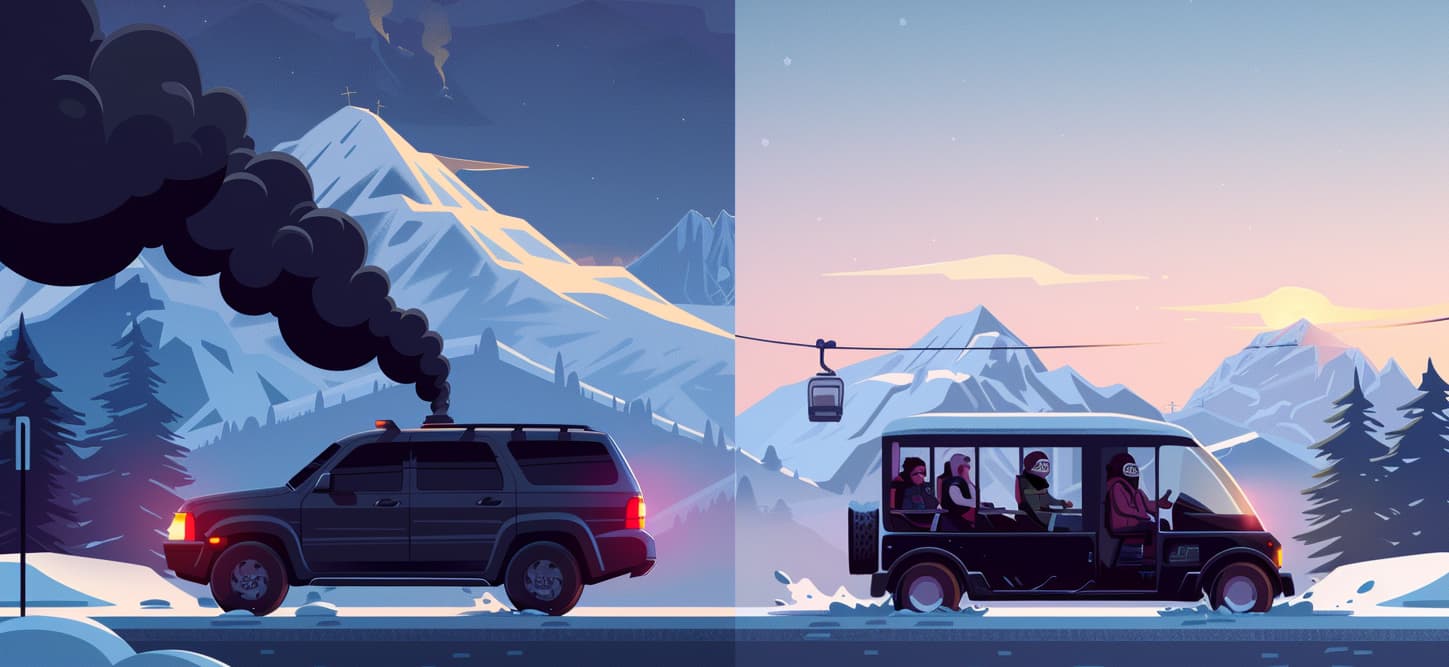
Most Vancouver skiers drive to Whistler, and most of those cars have one or two people in them. It feels like the bus or a full carpool should be way better for emissions, but by how much? And how bad is the helicopter, for anyone with the budget for one?
I wanted to put actual numbers on it, so we built a small calculator. Pick a vehicle, enter how many people are in it (including the driver), and it gives you the CO2 per person for one trip from Vancouver to Whistler.
How the calculator works
It assumes a one-way trip of 120 km, which is about the drive from central Vancouver to Whistler Village up the Sea-to-Sky (Whistler's own page says 127 km, depending on where you start). Then it multiplies fuel used by how much CO2 that fuel makes when it burns:
- Small car (like a Honda Civic): 9 L/100 km of gasoline, at 2.3 kg CO2 per litre
- Large SUV (like a Toyota 4Runner): 14 L/100 km of gasoline
- Electric car: 16 kWh/100 km of BC electricity
- Bus (like Epic Rides): 38 L/100 km of diesel, at 2.7 kg per litre, with 40 people on board
- Helicopter: a Bell 407 burning about 170 L of jet fuel an hour, at 3.15 kg per litre
It only counts what comes out of the tailpipe (or the exhaust). Building the car, refining the fuel and making the battery all add more, but they vary too much from car to car to put in a simple tool.
What the numbers say
For one person going one way:
- Solo in a small car: about 24.8 kg
- Solo in a large SUV: about 38.6 kg
- Four people in that SUV: about 9.7 kg each
- Four people in a small car: about 6.2 kg each
- On a full bus: about 3.1 kg
- Electric car, solo: under half a kilo
- Helicopter with five passengers: about 71 kg each, and 355 kg for the flight
Double all of that for the trip home.
How many people are in the car matters more than which car it is. A solo SUV driver puts out about six times what each person in a full small car does, so filling the empty seats beats most car upgrades.
The bus is close to the best you can do in anything that burns fuel. The calculator assumes it's full, though. A half-empty bus doubles the per-person number to about 6 kg, which is still better than a solo small car.
Electric cars in BC
EVs come out looking almost free here, and that's mostly about where the electricity comes from. BC's grid runs mainly on hydro. The calculator uses BC Hydro's older figure of 11.5 g CO2 per kWh. The BC government's latest electricity emission intensity factor is 22.8 g per kWh (for 2025), which counts imported power too. Even at that higher number, a solo EV trip to Whistler is about 0.44 kg, still way below anything that burns fuel.
The same EV in a province or state running on coal would look very different, so this is a BC result, not a general one.
The helicopter
We put it in mostly for fun. Charter helicopters from Vancouver to Whistler exist, and they're the fastest way up, but at about 355 kg of CO2 per flight, one ride is roughly the same as 14 solo trips in a small car. Even shared five ways, each person is responsible for more than a solo SUV driver.
Getting to Whistler without a car
If you don't want to drive, there are buses most of the season:
- Epic Rides runs from downtown Vancouver to Whistler Village. A third-party listing had it at about $26 one way in mid-2026, but I couldn't confirm its winter 2026-27 fares, so check its site.
- YVR Skylynx runs from the airport and downtown, listing $32 one way and $42 return from downtown. Its winter 2026-27 schedule runs 22 November to 19 April.
Carpooling still wins on price
If you drive, the easiest change is to fill the car. Whistler Blackcomb gives free reserved parking on weekends in Upper Lot 6 and Creekside P1 to cars with four or more people, which is a big deal on a powder Saturday. Cypress gives drivers a $10 credit for carpooling with two or more.
Splitting fuel four ways also makes the trip cheap. We wrote up how to find a ride, and what's fair to pay, in our Vancouver ski carpooling guide.
I'd like to add the return trip and real routes from different neighbourhoods to the calculator at some point. A trip from Surrey is a lot longer than one from Kitsilano.